
The single best early warning that your flight will be delayed isn’t on the departures board. It’s the inbound aircraft: the plane that has to land, unload, and turn around before it can become your flight. If that aircraft is running late, your flight usually will be too, often hours before the airline updates the status.
Here’s how to read that signal, plus the other gate-to-gate details worth watching so you’re never the last to know.
The best predictor of a delay: your inbound aircraft
Most flights are flown by a plane that just operated another route. That earlier flight is your inbound aircraft, and the logic is simple: your plane can’t leave until it arrives. So if the inbound flight is 90 minutes late landing, your departure is very likely to slip by a similar amount, even while the board still says “On Time.”
To check it, find the tail number or inbound flight for your departure (many flight-tracking tools show it) and see whether that aircraft has landed or is still en route and running behind. An inbound that’s already at the gate and on time is the reassurance you’re looking for. One that hasn’t left its previous city yet is a red flag.
Check your gate and boarding time before you leave
Gates change more often than people expect, sometimes after you’ve already parked at the old one. Confirm your gate and boarding time before you head to the airport, and again once you’re through security. As a rule, boarding starts about 30 to 40 minutes before departure for a narrow-body and a little earlier for long-haul.
Where is my plane right now?
Live tracking closes the gap between “scheduled” and “actual.” Following your aircraft in real time, where it is, whether it has left the previous airport, how fast it’s closing on your origin, tells you more than a status label that only flips to “Delayed” once it’s unavoidable.
Does the aircraft’s age matter?
You’ll sometimes see an aircraft listed as, say, a “Boeing 757-300, 27 years old.” Age is mostly a curiosity: well-maintained older jets fly safely every day, and age alone doesn’t predict delays. What it can hint at is the cabin, since older aircraft may lack seat-back power or the newest interiors. If that matters to you, it’s worth a glance when you pick a fare.
Have your lounge and boarding pass ready at the gate
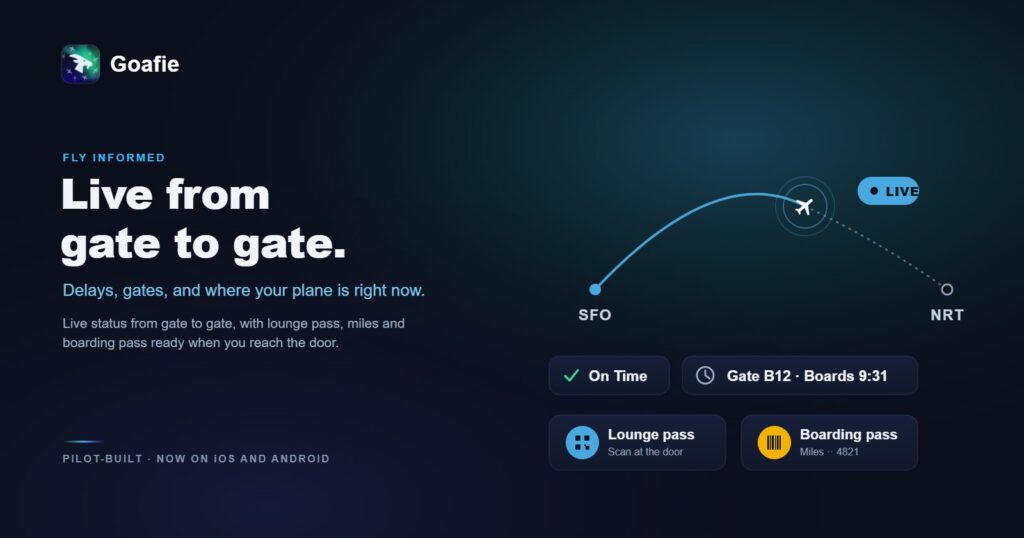
None of this helps if you’re fumbling for a QR code as the line moves. The point of a real travel companion is that the live status, your gate, your boarding pass, lounge access, and miles all sit on one screen, so the moment your inbound plane lands you already know what to do next. Goafie was built to do exactly that, gate to gate, on both iPhone and Android, for the traveller who has been handed a gate change at 6 a.m. on two hours of sleep. For years that polished experience only existed on iPhone, which is why “Flighty for Android” became such a common search. It doesn’t have to be one or the other anymore.
Catch delays before the airline does, free.
FAQ
How early can I tell if my flight will be delayed?
Often several hours ahead, by checking your inbound aircraft. If the plane assigned to your flight is running late on its previous leg, your departure is likely to slip well before the airline changes the posted status.
What is an inbound aircraft?
It’s the specific plane scheduled to operate your flight, arriving from an earlier route. Because your flight can’t depart until that aircraft lands and turns around, its lateness is one of the most reliable predictors of your own delay.
Why does the airline app show delays so late?
Airlines often hold off on posting a delay until it’s certain, to avoid rebooking chaos. Independent live-tracking data, such as aircraft position and inbound status, usually reflects reality earlier.
What time does boarding usually start?
Typically 30 to 40 minutes before departure for short and medium-haul flights, and a bit earlier for wide-body long-haul. Always check your specific boarding time, as it varies by airline and aircraft.